Concert Programs
Glass Harmonica and Verrophone
The Scent of Glass
The Current Concert Program
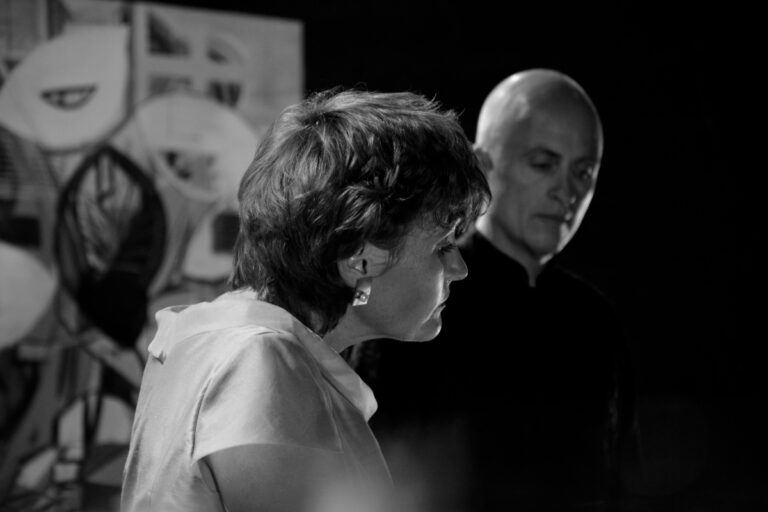
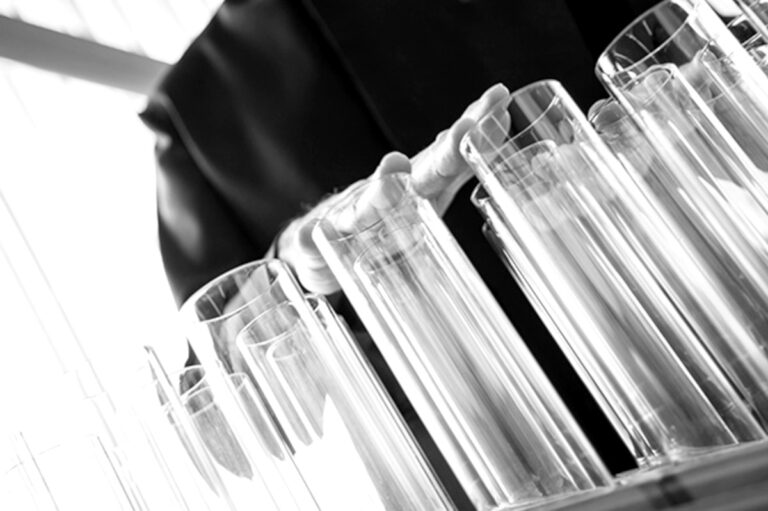
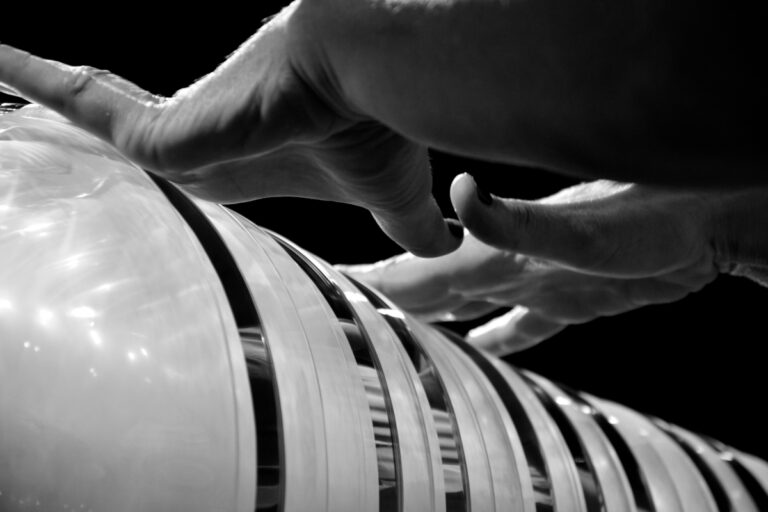
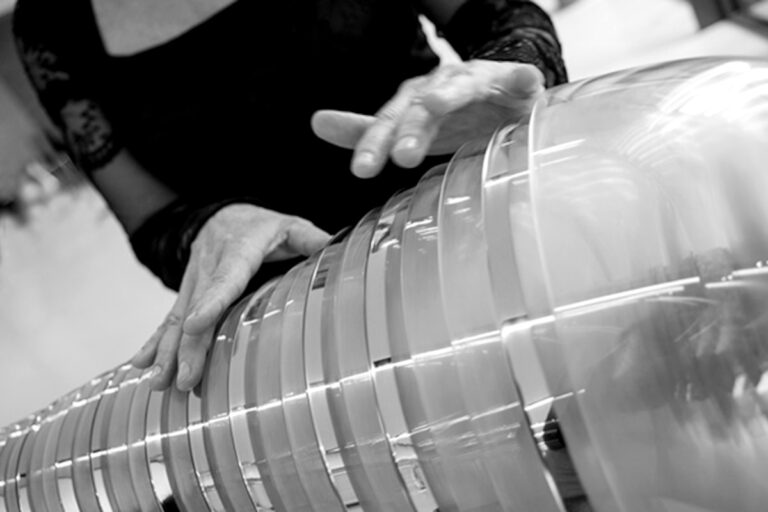
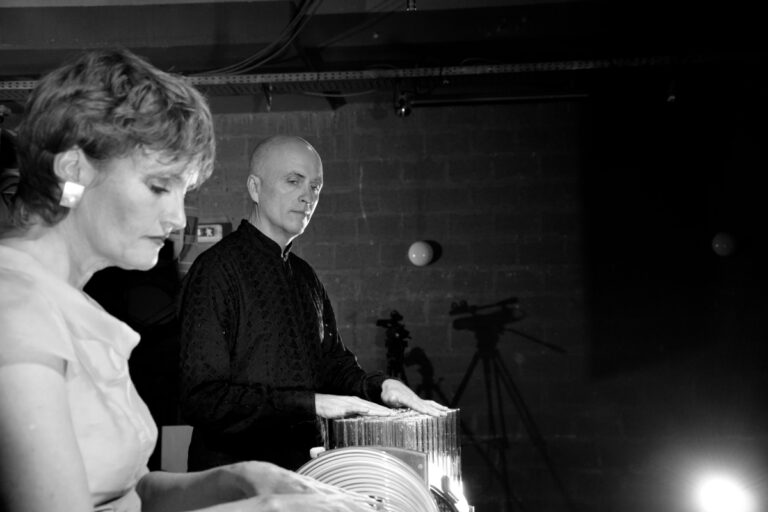
Featuring works from W.A. Mozart to Arvo Pärt, from Hildegard von Bingen to Ennio Morricone. “The glass harmonica is sounding glass in bowls, and the verrophone is sounding glass in tubes. When they sound, all that remains is tension and development and the question of the spectrum of hearing. No one has ever regretted this hearing. It is enjoyment in the wonder of what is possible, of what can be pushed to the limit—without any over-extension: purely as sound.” (Peter Wagner)
What the Press Says
Salzburger Nachrichten:
Der Musik dieses Duos kann sich niemand entziehen.
Die wahrlich magischen Musikkolorite durchströmten eine nahezu materialisierte Stille im Raum.
Mit spielerischer Brillanz entfalten die Musiker den faszinierenden Klang der Glasinstrumente. Das Wiener Glasharmonika Duo: Ein Gesamtkunstwerk von außergewöhnlicher Intensität.
Ein Highlight des diesjährigen Musiksommers.
Mozart's Last Glass
Mozart's Final Chamber Music Work
Six months before his death, Wolfgang Amadeus Mozart wrote his major works for the glass harmonica: an Adagio for solo glass harmonica and the Adagio and Rondo for glass harmonica, flute, oboe, viola, and cello, KV 617. Mozart had already become acquainted with the glass harmonica as a child in the home of the physician and animal magnetizer Franz Anton Mesmer. Writers, artists, intellectuals, and musicians met at his villa. Mesmer himself played the instrument with passion and skill and used the glass harmonica as part of his therapy.
Wolfgang Amadeus was fascinated by this instrument. His father Leopold wrote in a letter to his wife: “…Wolferl has already played on it too. Oh, if only we had such a glass harmonica…”
Unfortunately, this dream did not come true in that way. But in the last year of his life, Mozart was finally able to live out his fascination for this instrument. For a performance by the glass harmonica virtuoso Mariane Kirchgessner at the Vienna Kärntnertortheater in May 1791, Mozart composed the KV 617 for glass harmonica, flute, oboe, viola, and cello. At the premiere, Mozart likely played the viola himself. The Solo Adagio for Glass Harmonica KV 617a was also created on the occasion of this concert.
What the Press Says
Die Nürnberger Nachrichten zu dem Programm "Mozarts letztes Glas":
„...Das Wiener Glasharmonika Duo demonstriert durch die Wahl der Kompositionen rund um Mozarts „letztes Glas" das unerhörte Klang- und Ausdrucksspektrum ihrer Instrumente. Die virtuosen, gleichzeitig kreativen und lustvollen Interpretationen bringen die musikalische Spannweite des sorgfältig ausgewählten Repertoires zur vollen Entfaltung. Leicht überträgt sich die experimentelle Musizierlust und bestechend ertönt die technische und musikalische Reife der so schlicht wie komplex gestalteten Kompositionen von frühen Mittelalter bis zur Gegenwart, von Hildegard von Bingen bis Arvo Pärt...."
A Million Tones Between the Stars
The Solo Program
Christa Schönfeldinger, Glass Harmonica
Soundscapes between past and present, between silence and hovering movement.
In this solo program, Christa Schönfeldinger ranges widely, from Mozart, Schmittbaur, Bellini and Schubert to Jörg Widmann and Gerald Schönfeldinger.
The result is an extraordinary concert evening in which historical soundscapes and contemporary music combine to form a fascinating cosmos.
Music and Word
Selected Recited Texts
In the Beginning, the Night was Music
Music from Alissa Walser’s novel about Maria Theresia Paradis and Anton Mesmer.
The 2017 film “Mademoiselle Paradis” (Licht) by Barbara Albert brought renewed attention to this forgotten figure of Austrian
musical and cultural history.
Text selection: Dr. Maria-Christine Leitgeb, Music: Vienna Glass Harmonica Duo.
Actors from previous performances: Chris Pichler, Karl Markovitz
The Lifeblood of the World
A musical-literary seduction with texts by Johann Wolfgang von Goethe and the Vienna Glass Harmonica Duo.
Hardly any musician touched Goethe’s emotional world as impressively as the then-euphorically celebrated virtuoso on the glass harmonica, Marianne Kirchgessner.
Goethe heard “the lifeblood of the world” in the sounds of the glass harmonica. This program offers texts specifically tailored to the theme of Goethe and music and the Vienna Glass Harmonica Duo by Konrad Schrögendorfer (dramaturgy, Vienna Burgtheater). From melancholic to cheerful. Previous performances with: Senta Berger, Wolfgang Hübsch, Chris Pichler, and others.
The Glass Spider
Fantasy from the Depot
In this fantasy, which the author wrote specifically for the Vienna Glass Harmonica Duo, the glass instruments not only hold the central aesthetic role but also represent the essential source of inspiration for the narrative through their unique tonality. “The Glass Spider,” in its text-music ping-pong, stands in the tradition of Prokofiev’s “Peter and the Wolf” or Saint-Saëns’ “Carnival of the Animals.”
What the text does not tell, because it cannot or should not tell it, the music tells—and vice versa.
See also: www.peterwagner.at
Floating Glass
Compositions for Glass Instruments
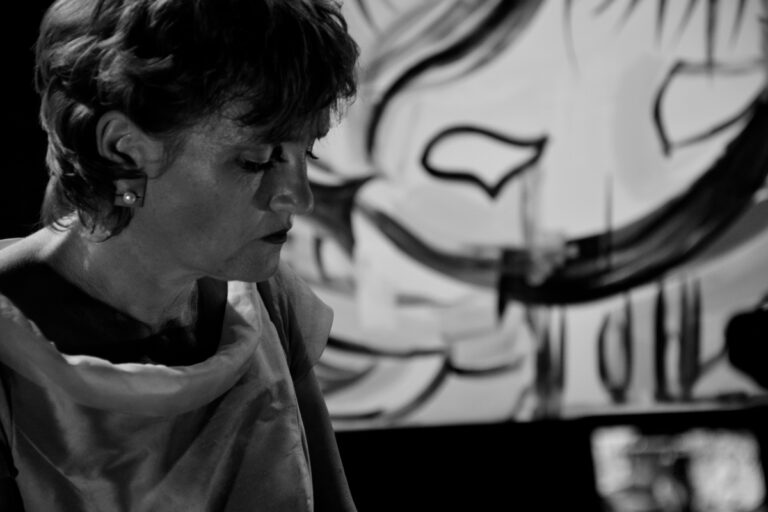
The new concert dramaturgy of the Vienna Glass Harmonica Duo, which takes into account the requirements of a contemporary stage presentation without advocating for the superficial, speculative use of effects. The use of light and video dramaturgy serves solely to scatter the charisma of the glass instruments over the audience as sensitively as it is suggestively. The listener can virtually enter the interior of the instruments; they hear while seeing, and see while hearing.
With the writer and film artist Peter Wagner, the Vienna Glass Harmonica Duo has found a congenial partner for the intended intensification of their concert program on stage. Without thundering down the sensitive musical construct with excessive visualization, the calculated use of colors and light manages to place the free spaces of hearing on a further suggestive level and lead the sound to a holistic experience. The seduction succeeds all the more because it does not impose intrusive elements on the viewer, but rather depth.
With “floating glass,” the Vienna Glass Harmonica Duo presents a very attractive variation of their concert performance, which appeals to young and old audiences alike.
Glass Music with Fun
An Enjoyable Hour
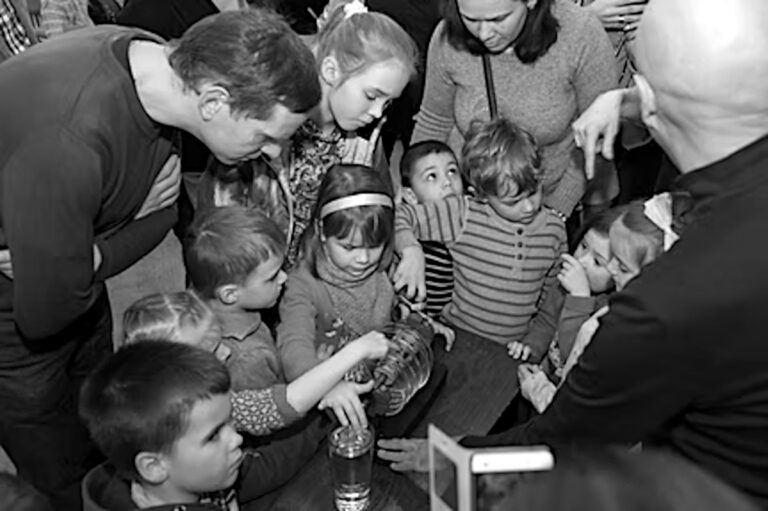
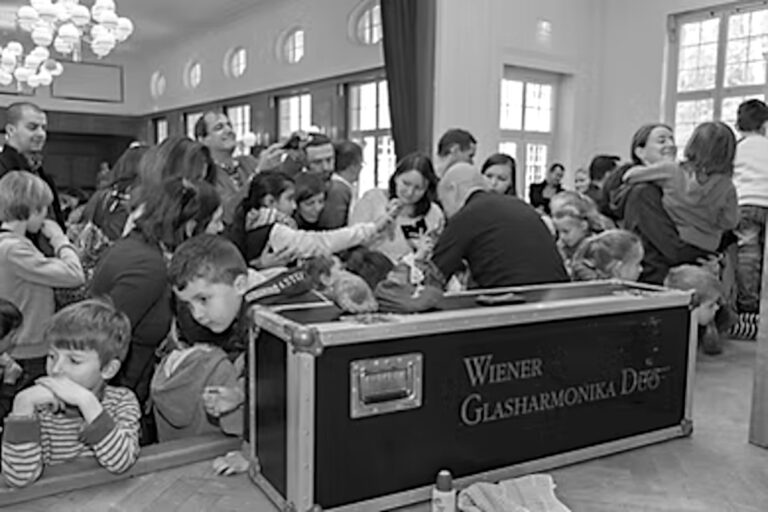
With this program, the Vienna Glass Harmonica Duo presents an enjoyable hour for little (and big) adults.
Creating sounds from glass, asking questions, singing along, whistling along—(almost) everything is allowed. Christa and Gerald Schönfeldinger enchant their young listeners aged 6-12 with the glass harmonica and the verrophone in a children’s and family concert program of a special kind.
The Whispering of the Stars
Music Specially for the Christmas Season
Sternenklänge: drifting into the stillness of Christmas with the sound magic of the glass harmonica. Its delicate, ethereal tone brings light to listeners’ faces, and not only at Christmas.
The new Christmas program of the renowned Viennese ensemble is an invitation to listen and to slow down, with works by H. Purcell, W.A. Mozart, J. Haydn, F. Schubert, R. Schumann, Arvo Pärt, as well as pastoral melodies from Salzburg and Tyrol, among others.
What the Press Says
Der Kurier über das Weihnachtsprogramm:
„...Was immer die Schönfeldingers spielen - und sie tun das mit "glänzender" Perfektion -, es kehrt irdisches und überirdisches Glück beim Zuhören ein. ... "
The glass harmonica is sounding glass in bowls, and the verrophone is sounding glass in tubes. When they sound, all that remains is tension and development and the question of the spectrum of hearing. No one has ever regretted this hearing. It is enjoyment in the wonder of what is possible, of what can be pushed to the limit—without any over-extension: purely as sound.
Peter Wagner